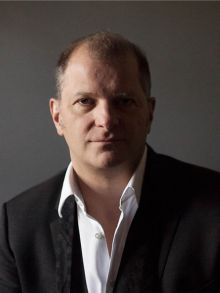
He initially studied German language and literature and sports science at the University of Graz, followed by directing at the University of Music and Performing Arts in Graz. After early work in Austria (primarily at the Schauspielhaus Graz) and at the Slovenian National Theatre in Ljubljana, from 1993 he was a resident director at the Schauspiel Stuttgart, for which he created numerous productions. It was there in 1996 that he also directed his first opera: „King Arthur“ by Henry Purcell. Further stations in his career included the Burgtheater Vienna, the Thalia Theater and the Schauspielhaus in Hamburg, the Volksbühne in Berlin, the Zurich Opera House, the Salzburg Festival, the Berlin State Opera, the Royal Opera House Covent Garden, Het Muziektheater Amsterdam, the operas in Naples and Bologna, the Teatro Stabile di Torino, the Teatro Real in Madrid, the Opéra de Lyon…
In 2005/2006, Martin Kušej headed the drama section of the Salzburg Festival, where, in a co-production with the Burgtheater Vienna, he presented Franz Grillparzer’s „König Ottokars Glück und Ende“ and Johann Nestroy’s „Höllenangst“. In 2008, he opened Nikolaus Bachler’s artistic directorship at the Bavarian State Opera in Munich with Giuseppe Verdi’s „Macbeth“. This was followed by Dvořák’s „Rusalka“ and Verdi’s „La Forza del Destino“. Between 2011 and 2019, Martin Kušej was Artistic Director of the Residenztheater in Munich. During this time, he created works such as „Faust“, „The Bitter Tears of Petra von Kant“, „Hedda Gabler“, „Ivanov“, „Don Carlos“ and „Noises Off“. Kušej’s productions have received numerous awards; his work has been invited to the Berlin Theatertreffen three times, and he has also received the Nestroy Theatre Prize on several occasions. From 2019 to 2024, he was Director of the Burgtheater in Vienna.
Significant for my teaching is …
… being challenged by the curiosity, imagination and creativity of my students. In doing so, I would like to pass on as much of my experience and knowledge in this profession as possible, but above all to instil in them a clear awareness of their work as „theatre creators“.
 Deutsch
 English (UK)